The Aubusson Tapestry Museum is situated in an exceptional context shaped by a rich history and a powerful natural environment. The Creuse capital of tapestry has been marked by its history since the royal manufactory of the 14th century. Its landscape is characterized by a granite base carved by the Creuse and the Beauze rivers, flanked by two wooded hillsides. This entire valley-town is dotted with historic monuments that form the northern panorama of the museum garden, with at its center the Clock Tower, a remnant of the protective wall that once surrounded Aubusson.
The power of the site
The strength of this landscape is expressed through the movement of rocky hori- zons, revealed around the bend of a valley or a rising path. In some places, water sparkles amid chaotic rock formations; elsewhere, sphagnum moss and cotton grasses bloom in the heart of dense forests and wetlands—elements that owe their character to a preserved, sometimes dominant, natural environment.
The museum extension project echoes this generous nature as seen from the northern garden across the opposite hillside. This staging of an idealized nature also extends into the dreamlike landscapes of tapestry art.
The architectural approach
“The garden is a carpet where the entire world comes to accomplish its symbolic perfection, and the carpet is a kind of mobile garden moving through space. The garden is the smallest parcel of the world, and yet it is the totality of the world. Since ancient times, the garden has been a kind of joyful and universalizing heterotopia.” Michel Foucault, Of Other Spaces (1967)
Historically, the carpet and the garden are closely linked. The Persian garden—the enclosed paradise—is at the heart of Persian carpet imagery. The carpet thus becomes a territory, a surface opening onto infinity. In the West, where carpets take on a more pictorial dimension, garden representations are also very present, particularly through vegetal motifs widely used in Aubusson tapestry.
The extension project is rooted in this poetic dialogue. It is conceived primarily as a lush, landscaped garden from which a monolithic piece of architecture emerges at its center.
Located at the highest point of the site, the extension offers views toward the Clock Tower to the north, across the valley—also emerging from the vegetation—creating a visual dialogue at a distance.
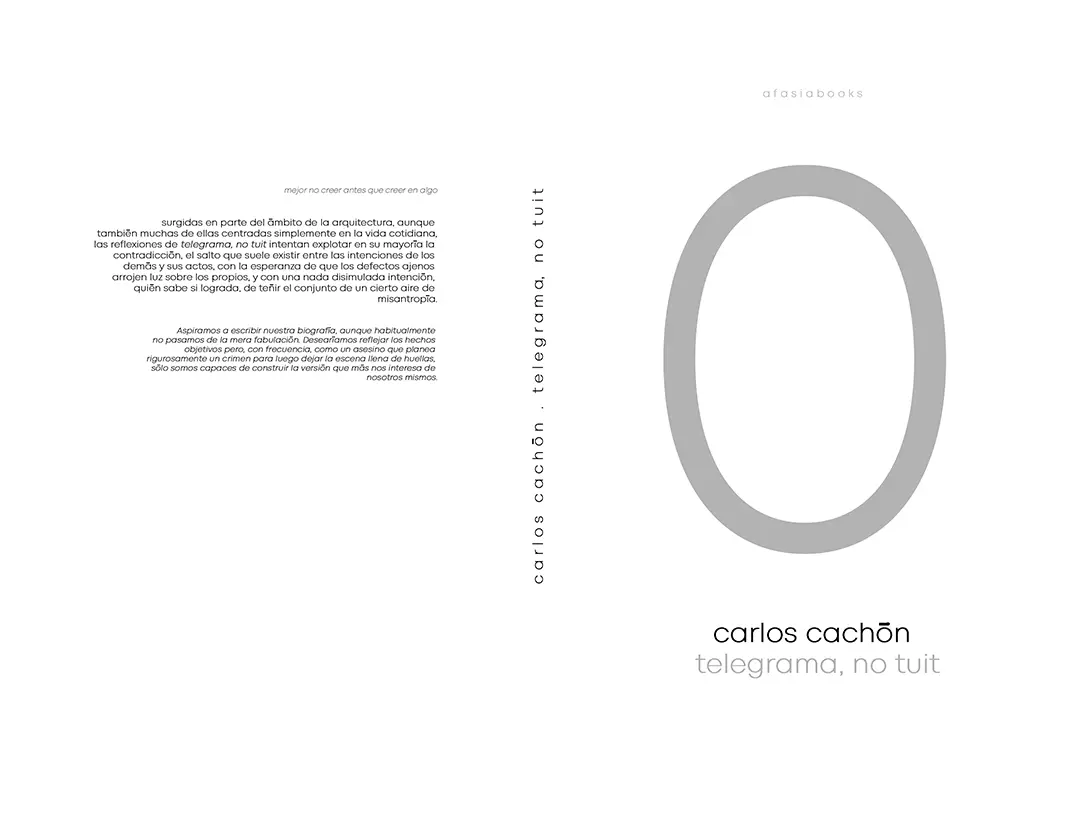
Upon closer observation, the monolith’s surface is composed of fluted textures. These subtle variations in the thickness of the concrete create vibrations through cast shadows. The relief comes from the imprint of woven reed mats integrated into the formwork of the cast-in-place concrete.
Rare glazed openings puncture the monolith, revealing the interiors and projecting them toward the landscape.
Siting
Set within the revitalized garden, the mineral mass is visually detached from the existing building.
Placing the extension separately from the original structure preserves as much of the outdoor landscape as possible, particularly to the south of the grand nave. This
maintains visual permeability on both sides of the built masses and allows for a larger garden. Moreover, the symmetrical cross-shaped plan of the existing building did not lend itself to a harmonious extension. The original structure already possesses a strong autonomy and is well integrated into its immediate site; distancing the extension preserves this balance.
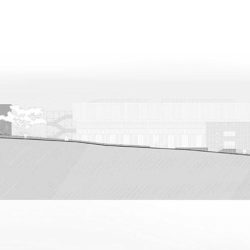
The terrain naturally slopes upward. As a result, the extension sits at a higher level than the existing building.
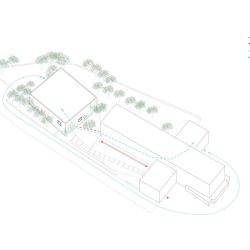
The project is organized on two levels: a lower level aligned with the grand nave, and an upper level directly connected to the parking area and delivery zone to the west. Connection is achieved through an underground gallery extending from the grand nave to the two-level entrance hall of the new building. On the lower level, the hall links the nave to the first two exhibition rooms; on the upper level, it opens onto the landscape, offering the most beautiful view of the site, and connects to the two other exhibition rooms.
The garden is a key element of the site and must remain as generous as possible.
By stacking exhibition rooms in pairs, the building’s footprint within the garden is minimized. The project is therefore deliberately compact, freeing up maximum space for the landscape and maintaining a necessary balance between built and open space.
Visitor Circulation
The extension rises from the middle of the garden and is linked to the existing museum via an underground access. A gallery connects the end of the grand nave to the lower level of the new entrance hall, leading visitors toward the first two exhibition rooms.
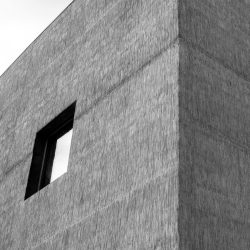
Visitors then ascend via monumental staircases (or an elevator) to reach the upper level. The intertwined stair flights create dynamic views—both upward and downward—offering a theatrical experience that echoes the staged ambiance of the grand nave.
At the top, the hall serves as a transitional space to the two upper exhibition rooms. A large picture window expands the space toward the wooded horizon of the valley, where a lounge area invites visitors to pause midway through their journey.
After visiting the upper galleries, visitors descend back to the lower level and return to the main museum reception via a covered gallery along the existing building.
The route thus forms a loop that can be experienced in either direction. Temporary exhibition spaces can either initiate or conclude the visit, or be accessed independently of the permanent galleries.
Access and programmatic connections
Functional links and usable areas meet, and even exceed, the requirements of the architectural and technical program.
The programmatic layout and access points are clearly organized into three zones within the extension, spread across two main levels and several intermediate half-levels. East: reception hall, office, and storage / West: logistics spaces and additional storage / Center: exhibition rooms.
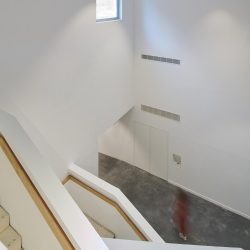
Public reception and exhibition areas are located on two levels, comprising four exhibition spaces that strictly adhere to the program’s dimensions and are organized around a monumental double-height hall.
In a future expansion of the permanent collection, the two lower-level temporary exhibition rooms could be integrated into the permanent route, while the upper rooms remain dedicated to temporary exhibitions.
The four galleries can operate independently or as a single large exhibition, as all are directly accessible from the hall.
One temporary exhibition room is designed to function autonomously if needed, with its own control room and directly connected installation space. When the museum is closed, this room can be accessed independently via a southern entrance connected to Rue Williams-Dumazet through an existing ramp.
From the exterior, the logistics and storage areas, spread across four levels are accessed via the west façade, where a delivery zone connects directly to a reception area through a large monumental opening. This space is linked to the exhibition areas and connected by freight elevator to the lower-level
storage rooms. On the same level are located technical control rooms, exhibition assembly spaces, and storage for crates and handling equipment.
_











Location
France, Aubusson
Surface
1800 m2
Team
Projectiles, architect (project manager)
Base, landscape designer
Batiserf Ingénierie, structure engineering
Louis Choulet, flood engineering
Bureau Michel Forgue, construction economics
Abraxas, light designer
Aïnu, conservation
Orfea acoustique, acoustician
Client
Syndicat mixte de la Cité internationale de la tapisserie et de l’art tissé