Flury + Furrer . photos: © Katalin Deér
A refurbished historical bathhouse with a swimming pool and a studio hall made from re-use components together form a new ensemble on the Sitterwerk site in St. Gallen. This continues the transformation of the former industrial area into a vibrant place of cultural production featuring institutions such as the Kunstgiesserei, the Sitterwerk Foundation, and the Kesselhaus Josephsohn. The invited artists receive a new workspace, and the people working on the site gain a new meeting point. The architects Flury + Furrer have been closely connected to the Kunstgiesserei for over 20 years as employees and planners. The bathhouse and studio hall follow the same principles that characterize their earlier conversions on the site: the careful continuation of the location’s history, the reuse of materials and structures, a site-specific and collective building process, and the aim for a simple yet craft-based and design-oriented architecture.
The Kunstgiesserei St. Gallen did not only function as the client for the new ensemble. A “Bauhütte” (building lodge) was formed from the ranks of its employees and the architects, where the architects planned on-site and contributed manual labor. The local craftsmanship and the collective search for solutions shaped the architecture. With the involvement of heritage conservation and universities, the project simultaneously took on a public character.
The ensemble fulfills several needs: the bathhouse with its swimming pool creates a new meeting point and leisure facility for the many people active in the Sittertal. The studio hall serves the invited artists of the Sitterwerk Foundation as a place for working, living, and exhibiting. Easily adaptable and open to various uses, it can be utilized differently in the future.
The bathhouse and studio hall follow the principles of preservation, re-use, and resource-saving construction. While the historical substance of the bathhouse was carefully restored and made usable again, the studio hall consists largely of reused building components. The simple construction and ecological materials allow for easy dismantling and further reuse.
Like all construction projects for Sitterwerk and the Kunstgiesserei, the project is based on economic self-responsibility and self-supervision. It exemplifies the economy of the “Bauhütte” principle, which combines artisanal knowledge with short distances and efficient decision-making on-site. With economical architecture, a long-term investment in the location and its cultural use is achieved.
The combination of the publicly usable bathhouse with a swimming pool and the culturally used studio hall contributes to the diversity and openness of the site. The ensemble creates an inspiring coexistence of art and life, of athletic refreshment and social and cultural exchange. This also promotes the sense of community among the different user groups on the site.
The ensemble continues the characteristic conglomerate of old and new in the Sittertal. Situated opposite the large industrial halls, the studio hall is oriented toward the smaller scale of the manufacturer’s villa and the bathhouse. Many re-use components come from the immediate or regional context, such as the insulation from a workshop on the site, the gate from an OLMA hall, and the glulam beams and staircase from one of the demolished Huber pavilions at ETH Zurich.
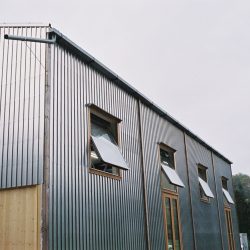
With the restored bathhouse, the history of the place—particularly the Sitter river as an energy source for early industry—is made tangible again. The studio hall fits into the genius loci with its pragmatic architecture. The cladding made of Fural aluminum strips refers to typical industrial hall facades, but also to the shingle cladding of the bathhouse.
Crafted precision and a thoughtful construction, balanced proportions, and appropriate materials lead to an aesthetic that radiates clarity and calm despite the heterogeneity of the reused components. ·
Text: Marcel Bächtiger
_




Ein instandgesetztes historisches Badhaus mit Schwimmbecken und eine Atelierhalle aus Re-Use-Bauteilen bilden zusammen ein neues Ensemble auf dem Areal des Sitterwerks in St.Gallen. Damit wird die Transformation des ehemaligen Industrieareals in einen lebendigen Ort der kulturellen Produktion mit den Institutionen von Kunstgiesserei, Stiftung Sitterwerk und Kesselhaus Josephsohn fortgeschrieben. Die eingeladenen Kunstschaffenden erhalten eine neue Wirkungsstätte, die auf dem Areal arbeitenden Menschen einen neuen Treffpunkt. Die Architekten Flury + Furrer sind der Kunstgiesserei als Mitarbeiter und Planer seit über 20 Jahren eng verbunden. Badhaus und Atelierhalle folgen denselben Prinzipien, die auch ihre früheren Umbauten auf dem Areal auszeichnen: die behutsame Fortschreibung des Orts, die Weiterverwendung von Materialien und Strukturen, ein ortsbezogener und kollektiver Bauprozess sowie der Anspruch auf eine schlichte, aber handwerklich und gestalterisch überzeugende Architektur.

Die Kunstgiesserei St.Gallen fungierte nicht nur als Bauherrin des neuen Ensembles. Aus den Reihen ihrer Mitarbeiter und den Architekten formte sich auch die Bauhütte, bei der die Architekten auf der Baustelle planen und handwerklich mitarbeiten. Das Handwerk vor Ort und die gemeinsame Lösungsfindung prägt die Architektur. Mit dem Einbezug von Denkmalpflege und Hochschulen erhielt das Projekt gleichzeitig einen öffentlichen Charakter.

Das Ensemble erfüllt mehrere Bedürfnisse: Das Badhaus mit Schwimmbecken schafft einen neuen Treffpunkt und ein Freizeitangebot für die zahlreichen Menschen, die im Sittertal tätig sind. Die Atelierhalle dient den eingeladenen Kunstschaffenden der Stiftung Sitterwerk als Arbeits-, Wohn- und Ausstellungsort. Einfach adaptierbar und nutzungsoffen, kann sie in Zukunft auch anders genutzt werden.

Badhaus und Atelierhalle folgen den Prinzipien von Erhalt, Re-Use und ressourcensparendem Bauen. Während die historische Substanz des Badhauses sorgfältig restauriert und wieder nutzbar gemacht wurde, setzt sich die Atelierhalle zu grossen Teilen aus wiederverwendeten Bauteilen zusammen. Die einfache Konstruktion und ökologische Materialien erlauben eine einfache Demontage und Weiterverwendung.

Das Projekt basiert wie alle Bauprojekte für Sitterwerk und Kunstgiesserei auf wirtschaftlicher Eigenverantwortung und Eigenaufsicht. Es zeigt beispielhaft die Ökonomie des Bauhütten-Prinzips, das handwerkliches Wissen mit kurzen Wegen und effizienter Entscheidungsfindung vor Ort kombiniert. Mit sparsamer Architektur gelingt eine langfristige Investition in den Ort und seine kulturelle Nutzung.

Die Kombination von öffentlich nutzbarem Badhaus mit Schwimmbecken und kulturell genutzter Atelierhalle trägt zur Vielfältigkeit und Offenheit des Ortes bei. Das Ensemble schafft ein inspirierendes Nebeneinander von Kunst und Leben, von sportlicher Erfrischung und sozialem und kulturellem Austausch. Damit wird auch der Gemeinsinn der verschiedenen Nutzergruppen auf dem Areal gefördert.

Das Ensemble schreibt das charakteristische Konglomerat von Alt und Neu im Sittertal fort. Gegenüber den grossen Industriehallen gelegen, orientiert sich die Atelierhalle am kleineren Massstab von Fabrikantenvilla und Badhaus. Viele Re-Use-Bauteile stammen aus dem unmittelbaren oder regionalen Kontext, so z.B. die Dämmung aus einer Werkhalle auf dem Areal, das Tor aus einer OLMA-Halle und die Brettschichtträger und die Treppenanlage aus einem der abgerissenen Huber-Pavillons der ETH Zürich.

Mit dem restaurierten Badhaus wird die Geschichte des Ortes – insbesondere die Sitter als Energiequelle für die frühe Industrie – neu erlebbar gemacht. Die Atelierhalle schreibt sich mit ihrer pragmatischen Architektur in den Genius Loci ein. Die Verkleidung aus Fural Aluminiumbänder verweist auf typische Hallenfassaden der Industrie, aber auch auf die Schindelverkleidung des Badhauses.

Handwerkliche Präzision und eine durchdachte Konstruktion, ausgewogene Proportionen und angemessene Materialien führen zu einer Ästhetik, die trotz der Heterogenität der wiederverwendeten Bauteile Klarheit und Ruhe ausstrahlt.