Zurita Studio . Kalibra arquitectura . photos: © Ulrich Stockhaus
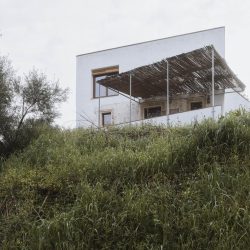
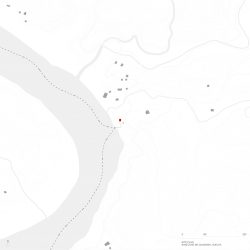
The project begins from what is already there. An old, ruined border post on the banks of the Guadiana, where Spain and Portugal meet, becomes the foundation for a new domestic life.
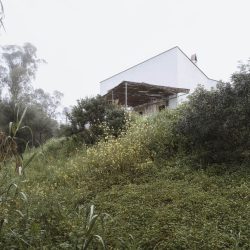
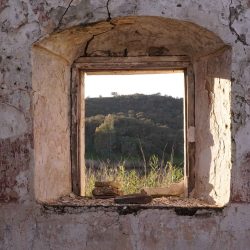
The design builds upon what’s already there. The perimeter stone walls are preserved as the main framework of the house, guiding the new construction that emerges within and above them. A new upper volume introduces height and light, opening toward the river with a large square window that overlooks the landscape once guarded from this post. An extension to the rear of the ruin accommodates the kitchen, bathroom, and secondary leisure space.
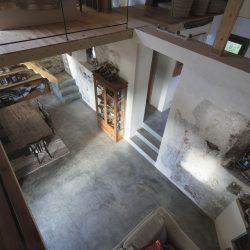
Inside, space flows without corridors or partitions. The old enclosure defines soft limits, spaces that are suggested rather than divided. The house adapts to its occupants and to the seasons: cool under the high ceilings and stone mass in summer, easily warmed in winter with a single stove. It is a place for one or for many, intimate yet shared, where privacy unfolds in degrees rather than behind walls.
Reuse is not approached as a theme but as a method. From the outset, the project assumed that what already existed (both materially and infrastructurally) could and should be reintegrated. In this renunciation of total control, a form of generosity emerges. The cast-iron stove, the cooking appliances, the pantry, and fragments of previous constructions were all absorbed into the design. Even the staircase and kitchen counter were made from remnants of the same site: wooden beams reused after completing the roof. This continuity gives the house an economy of means and a coherence that is not decorative but structural.
The result is a house that feels both grounded and immediate, spontaneous yet deliberate. The project becomes a frame for new life rather than a finished product. There are solid, permanent materials, and others, more fragile, more ephemeral, that will change over time. It is conceived as a minimal infrastructure from which to continue inhabiting the place.
Piedra y Agua is not a reconstruction, but a reactivation: an exercise in continuity, where the act of building becomes inseparable from the act of inhabiting.
_








Piedra y Agua
VI COAS (Colegio Oficial de Arquitectos de Sevilla) Architecture & Society Awards 2025: Architecture and Pre-existence – Residential Use
Location
Camino del Romerano,
Sanlucar de Guardiana. Huelva
Client
Olga Sánchez Garrido
Architects
Zurita Studio + Kalibra arquitectura
Manuel Silva Zurita, Simone Lorenzon, and Valeria Polato
Instagram
@zurita______
@kalibra.arquitecture
Budget
80.000€
Program
Renovation of a single-family home
Surface area
91.50 m2
Construction management
Manuel Silva Zurita
Photographs
Ulrich Stockhaus
Project dates
Completion: 2023
Construction company
Pedro Madrid / Cocodrile techos
Materials used
All materials follow a logic of austerity, with the reuse and recycling of existing materials and the use of local and available materials. The appliances, pantry and the fireplace cassette are reused.
Existing local stone: Foundation and base support, reuse of original ruins as structural base
Laminated wood (treated pine): New main structure supporting roof and loft
Galvanized steel: Minimal metal structure for terrace
Lime mortar: Simple, white, permeable finish
Cement: Simple, low-cost, low-maintenance interior flooring
Reinforced concrete: Tie beams, foundation slab extension
Passive/bioclimatic systems
Cross ventilation
Roof orientation to minimize the impact of the setting sun
Thermal mass
Natural lighting
Air stratification
Stove
Continuous and open space
Sustainable materials
Outdoor shade
VI COAS (Colegio Oficial de Arquitectos de Sevilla) Architecture & Society Awards 2025: Architecture and Pre-existence – Residential Use
Colegio Oficial de Arquitectos de Sevilla – COAS – Awards Jury Comment
The jury highlights the delicate way in which the designers reinterpret and adapt the ruins of an old border post on the banks of the Guadiana River opposite Portugal into housing, with a tight budget and complicated access conditions.
It maintains the perimeter walls as traces of the past and generates new spatial relationships, increasing the initial volume and constructing a double-height space and a new floor module that subtly turns one of its facades towards the landscape.
The proposal’s ability to generate new, high-quality architecture that is open to the environment and preserves the memory of the place has been valued, using traditional construction systems and materials, but seeking spatial fluidity and a contemporary image.
All this, moreover, with an intelligent use of ventilation, natural air currents, and the hygrothermal characteristics of these traditional materials, to achieve a home with optimal climatic performance.