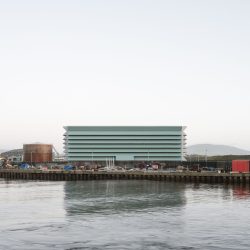
Arklow Wastewater Treatment Plant is the first time an architect has been a part of the design team for such a building. Here a small architecture practice won an invited competition and worked alongside the engineers to instrumentally direct and shape the plants design. Arklow has been without wastewater treatment for its entire history, Its badly polluted river and sea act to prevent the towns ability to grow, and badly impacted ecologies and the amenity value of these water bodies. Previous attempts to build a plant had failed repeatedly as previous designs did not meet planning approval on sensitive sites.
An Open conversation
The site here was selected as it sat at the centre of gravity of the town and offered the lowest carbon and energy profile for the plant. This site was also highly visible, and close to sensitive ecological sites. A conventional low lying and open plant was not appropriate. The architects used a design method based on an open conversation with the town, the engineers, the planners and more. Proposing that the design would find its expression in the multiple contingencies of these diverse inputs.
Civic Infrastructure
The result is a compact, low energy approach, Instead of excavating to sink tanks we proposed that all works be placed on the land. This both avoided confronting pollutants in the ground (a legacy of the sites pervious industrial use) and avoided the removal of any soil from the site. We then stacked the processes to involve less site coverage. Unlike a conventional plant which pumps many times from tank to tank, here there is one pump, with the remaining flow assisted by gravity, dramatically reducing energy needs. These stacked forms need servicing so a roof was made with robotic gantry cranes. The roof holds a solar farm, using PV generation to offset the plants energy use. The main functions of the plant are held in two primary forms, each held with a louvred skin which distributes air, assists with odour control and hides the operation of the plant from view. This screening allows the plant continue to change and develop internally as required in the future, to a town size of 36’000 people, three times its current population. The louvres are also seen as habitats for bats and nesting birds. Operation of the plant will provide access to, by remediation of, the currently highly polluted Avoca River and the towns coastline providing an immeasurable uplift in the health and wellbeing of the town. The compact form of the plant allows much of the site to be re-wilded.
The louvred skin was calibrated so that it would be a caricature from a distance, and characterful
in closer proximity – changing its atmosphere in rain, sun and at night. The two major built forms are held to present a choreography to the wider landscape, while a smaller laboratory building holds the street and sets up a more urban future for the immediate context.
Figure, Memory and Form
This site contains a strong memory of industry and employment in the town, and it was proposed that the plant might represent a new piece of civic infrastructure. The design that emerged in conversation between the people of the town, its history, form, ecology and environment was a radical reinvention of a typical water treatment plant. The result is civic infrastructure, a building that speaks of the public good. The design is innovative in how it configures itself to reduce energy use, enable adjacent ecologies and embody local narratives and memories.Its completion now allow for a sustainable development of the town alongside clean waters (river and sea). It sets an optimistic future for Arklow, and the potential for Irelands urban and infrastructural development to deliver care, excellence and innovation.
On Materials
The primary building material of the buildings is the walls of the tanks, all formed of reinforced concrete. Decorative elements are elaborated from this vernacular to make feet from which steel portal frames rise to hold the rest of the structure.
The facades of the primary processing structures are made in Ondapress 57 by Swisspearl – in a custom run which allowed front and back to be coated with the same unique colour – chosen for the way it rhymed with the cultural and physical context of the site. The smaller laboratory building that marks the entrance is made in the same colour panel, also by Swisspearl, but from their Carat range of flat panels.
_




ARKLOW WASTE WATER NAME: Arlkow Waste Water YEAR: 2015 – 2024 PLACE: Arklow, Wicklow Country Council, Ireland TEAM: Clancy Moore architects (Design, Detailed Design and ER for site works) Clancy Moore Team: Colm Moore, Andrew Clancy, David Magennis, Eerang Park, Alexandra Pickerill, Tobias Beale, Camilla Crafa, Piera Francesca Bedin CLIENT: Uisce Éireann / Irish Water LEAD CONSULTANTS: Ayesa Engineers CONTRACTORS: Ward & Burke (leaddajee) Demolition – Tinnellys Long Sea Outfall – Van Oord Structural Steel – Cavan Roofing and Engineering Cladding – Crown Roofing and Cladding Concrete Tunnelling Pipe – Tracey Concrete CFA Piling – Quinn Piling Bridge Piling – Mannings Conservation Engineers – Trevor Woods Consulting Engineers Architecture – Sean Dockry and Asosciates Structural Design – Coyle Kennedy PSDP – Tobin Consulting Engineers Concrete/Revetment Stone – Roadstone PFT – Shay Murtagh Precast Tarmacadam – Dan Morrissey Precast Piling – FK Lowry Electrical – EMCA Landscaping – Avondale Odour Control System – CMI Metal Platforms and Stairs – Mackey Plant MEICA Design – Ronan Meally and Associates Mechanical S/C – ALMS Electrical – EMCA Partitions – Suburban Ceilings Lift – Ascension lifts Tiling – All Star Tiling SITE: Internal Area: 12’234sqm Site Area: 3.2.Ha Marine Outfall: 900m to sea Wave Defences: 600m Tunnelling to reach site: 2.2km Arklow Population: 13’500 Plant Capacity: 36’000