A valley, a waterlogged landscape, an impermeable layer in the ground: the Dättnau clay plate. These, the reasons for the construction of the brickyard in 1896. With it, Dättnau also grew into a popular district of Winterthur. To the southwest lies a meadow, the construction site for the final stage of the new development, built on the site of the brickyard that burned down in 2015.
New buildings that carry on a legacy; a transformed landscape, rational processes, industrial facilities both literally and symbolically with tall smokestacks.
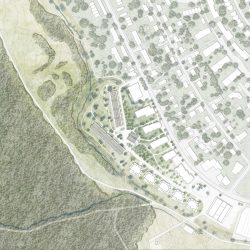
Water drains poorly here, it wants to stay, nourishing a revitalised meadow with alternating moisture levels. Accepting the clay soil not only as a material resource but also in this sense as a foundation leads to the positioning of the buildings along the edge of site, parallel to the stream and border of the forest. In the middle, the meadow is allowed to spread freely. Two horizontal residential buildings, a pavilion as mediator and a meeting place.
Elongated buildings and outdoor spaces alternate: common land – garden living – meadows – forest living – forest. All apartments are dual aspect and are enriched by different landscape views.
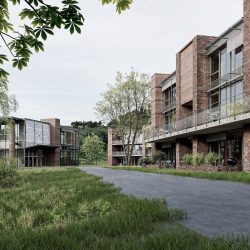
From the meadow side, the two 80m-long residential blocks form the entrance to the development. Their end facades mark the boundary to the surrounding green landscape, ambiguous in their expression: clay walls, recycled brick, chimneys, and steel windows – post-industrial, earthbound reminders of what was before, connecting with the existing and future landscape. The more delicate longitudinal facades are given rhythm by solid, monolithic-appearing building volumes. Fine details such as slim steel windows and railings, structured pergolas, and fabric awnings provide a light contrast. Carefully designed entrances and nuanced transitions from outside to inside address varying needs for contact and privacy.
Keller Enterprises, the owner based in neighbouring Pfungen, is itself directly involved in developing a range of unfired earth building materials: rammed-earth elements produced with robotics, pressed clay bricks, and recycled brick processing. Aware of the finiteness of their resource and the ecological drawbacks of fired bricks, they aim to increasingly put their expertise and production capacity into sustainable products using state-of-the-art methods. Dättnau IV thus also becomes a built case study of a forward-looking building system.
In this sense, costs and risks are addressed with a tiered construction concept. Not everything new is applied across the board but tested in deliberately chosen elements.
Garden Living
In the three-storey building between the commons and inner meadow lie 16 owner-occupied maisonette apartments. The lower apartments have a basement level and direct access to the meadow; the upper flats are reached by an open staircase as well as spiral staircases leading down from the terraces back into the meadow. Informal pathways connect people and outdoor spaces, reminiscent of the individual yet strong neighbourly character of a terraced housing estate.
A pragmatic approach has been implemented with a familiar cavity wall construction and well-tested materials – supported by the requirement of examining the components in terms of ecological aspects during manufacture. Trass lime, CO₂-enriched recycled concrete, and reused clinker bricks are used.
When viewed in terms of its life-cycle assessment, the clinker façade shows that with cavity wall construction, around 56% of greenhouse gas emissions can be saved (1,703 kg instead of 3,851 kg CO₂-eq/m² component*year) when recycled materials are used instead of newly produced ones.
Forest Living
The deep building volume defines the transition between the housing development and the forest. The 24 rental apartments are arranged transversely to the structural system into three spatial layers. From the central entrance area, the view reveals the open kitchen, which extends on both sides into the living spaces – living from façade to façade. The deep view into the forest is emphasised, the upper apartments with an extra high space offer views into the treetops.
Here, as part of a pilot project, selected components such as the stairwells and end facades with chimneys are developed with innovative construction methods. The partition walls, the load-bearing structure, are built fully monolithically; solid reused clinker brick walls on the ground floor form the load-bearing foundation for the rammed-earth elements used on the upper floors. The earthen gable walls are insulated from the inside and simultaneously serve as supports for the floor slabs. The connection is made via an anchor plate and a ring beam integrated into the earth element, which also enables the precise insertion of prefabricated elements.
For the larger spans between the partition walls and stairwells, a secondary load-bearing structure of slender timber columns with ribbed timber floor slabs is used.
The monolithic rammed-earth construction of the gable façade saves around 60% of greenhouse gas emissions compared to the cavity wall trass lime façade in the garden apartment building (0.750 instead of 1.890 kg CO₂-eq/m² component*year).
Pavilion
The pavilion as a neighbourhood meeting place is situated, surrounded by a gravel square, in the shade of silver willows and aspen trees. On the ground floor are the entrances to the bicycle room and underground garage, mailboxes and recycling station, as well as a community room; upstairs are studios. The community room, with its striking rammed-earth colonnade, can be expanded out onto the square through fully openable windows.
Ecological innovation takes centre stage in the pavilion. Monolithic rammed-earth elements and columns are combined with a hybrid steel skeletal structure and timber slabs. The three rammed-earth elements are not only structural but are also functional: the first integrates the stairway to the upper floor, the second forms a niche for the communal kitchen, and the third serves as a shaft for the ventilation systems. Alongside the powerful presence of these monolithic elements appear transparent and lightweight partitions of profiled glass. The interplay of heavy and light, solid and translucent, creates a spatial dramaturgy and gives the pavilion an identity-shaping uniqueness.
_






Ein Tal, vernässte Landschaft, im Boden eine Sperrschicht: Die Dättnauer Lehmplatte. Grund für den Bau der Ziegelei 1896. Mit ihr wächst auch Dättnau, beliebtes Quartier Winterthurs. Im Südwesten eine Wiese, Bauplatz für die letzte Etappe der neuen Siedlung, die anstelle der 2015 abgebrannten Ziegelei entsteht.
Neubauten, die ein Erbe antreten; verformte Landschaft, rationelle Prozesse, Industrieanlagen wörtlich wie sinnbildlich mit hohem Schornstein.
Das Wasser versickert hier schlecht, will bleiben, nährt eine revitalisierte wechselfeuchte Aue. Den lehmigen Grund nicht nur als Materialressource, sondern auch in dieser Hinsicht als Grundlage anzunehmen, führt zur Setzung der Häuser an den Rändern, parallel zu Bach und Waldrand. In ihrer Mitte darf sich die Aue unreguliert ausbreiten. Zwei laterale Wohnbauten, ein Pavillon als Mittler und Treffpunkt.
Langhäuser und Naturräume stehen im Wechsel: Allmend – Gartenwohnen – Aue – Waldwohnen – Wald. Alle Wohnungen sind beidseitig orientiert und werden von unterschiedlichen Landschaftseindrücken bereichert.

Von der Aue her bilden die beiden 80m langen Wohnzeilen den Auftakt zur Siedlung. Prägnant markieren die Kopffassaden die Grenze zum Naturraum, mehrdeutig in ihrer Sprache: Lehmwände, rezyklierter Backstein, Kamine und Stahlfenster – postindustrielle, erdgebundene Erinnerung an das, was vorher war, Verbindung mit der bestehenden und zukünftigen Landschaft. Die filigraneren Längsfassaden werden durch massive, monolithisch wirkende Baukörper rhythmisiert. Feine Details wie schlanke Stahlfenster und Geländer, strukturierte Pergolen und textile Markisen setzen einen leichten Kontrapunkt. Sorgfältig gestaltete Eingangsbereiche und nuancierte Übergänge von Aussen nach Innen tragen unterschiedlichen Bedürfnissen nach Kontakt und Privatheit Rechnung.
Die Keller Unternehmungen als Eigentümerin mit Sitz im benachbarten Pfungen bietet selbst Hand für die Entwicklung einer Produktpalette ungebrannter Erdbaustoffe: Stampflehmelemente, mit Hilfe von Robotik hergestellt, Presslehmsteine, Aufbereitung von Recycling-Ziegeln. Sich der Endlichkeit ihrer Ressource und der ökologischen Nachteile gebrannter Ziegel bewusst, wird sie ihr Fachwissen und ihre Produktionskapazitäten mit modernsten Fertigungsmethoden zukünftig vermehrt in den Dienst nachhaltiger Produkte zu stellen. Dättnau IV wird auch zur gebauten Case Study eines zukunftsweisenden Angebots.
In diesem Sinn wird Kosten und Risiken mit einem abgestuften Konstruktionskonzept begegnet. Nicht alles Neue wird gleich flächendeckend angewandt, sondern in bewusst ausgewählten Elementen getestet.

Gartenwohnen
Im dreigeschossigen Baukörper zwischen Allmend und Binnenaue liegen 16 Maisonettewohnungen im Eigentum, die unteren mit Souterrain und Ausgang direkt in die Aue, die oberen von einer offenen Treppenfigur erschlossen sowie Wendeltreppen, die von den Terrassen direkt wieder hinunter in die Aue führen. Die informelle Durchwegung verbindet Menschen wie Naturräume und erinnert an das individuelle und doch sehr nachbarschaftliche Wohnen einer Reihenhaussiedlung.

Es wird ein pragmatischer Ansatz mit bekannter Zweischalenkonstruktion und vertrauten Materialien verfolgt – unterlegt mit dem Anspruch, die Bauteile in ihrer Herstellung nach ökologischen Aspekten zu untersuchen. Trasskalk, CO₂-angereicherter Recyclingbeton sowie Reuse-Klinker kommen zum Einsatz.

Wenn die Klinkerfassade unter dem Aspekt der Ökobilanz betrachtet wird, zeigt sich: Bei einem zweischaligen Aufbau lassen sich rund 56 % der Treibhausgas-Emissionen einsparen (1.703 statt 3.851 kg CO₂-eq/m²BauteilJahr), wenn statt herkömmlicher Materialien rezyklierte eingesetzt werden.

Waldwohnen
Der tiefe Baukörper klärt den Übergang zwischen Siedlung und Wald. Die 24 Mietwohnungen sind quer zur Tragstruktur in drei Raumschichten gegliedert. Vom zentralen Eingangsbereich öffnet sich der Blick in die offene Küche, die sich auf beide Seiten zu den Wohnräumen erweitert – Wohnen von Fassade zu Fassade. Der tiefe Blick in den Wald wird inszeniert, die oberen Wohnungen mit einem überhöhten Raum bieten einen Ausblick in die Baumkronen.   Hier werden im Rahmen eines Pilotprojekts ausgewählte Bauteile wie die Treppenhäuser und die Stirnfassaden mit Kamin mit innovativen Bauweisen entwickelt. Die Schotten als primäre Tragstruktur werden vollständig monolithisch ausgeführt, massive Mauern aus Reuse-Klinker im Erdgeschoss bilden das tragende Fundament für die in den oberen Geschossen eingesetzten Stampflehmelemente. Die Stirnwände aus Lehm werden von innen gedämmt und übernehmen zugleich die Funktion als Deckenauflager. Der Anschluss erfolgt über eine Ankerplatte und einen im Lehmelement integrierten Ringanker, der zudem das präzise Einsetzen der werkseitig vorgefertigten Elemente ermöglicht. Für die grösseren Spannweiten zwischen Schotten und Treppenhäusern wird eine Sekundärtragstruktur aus filigranen Holzstützen mit Holzrippendecken eingesetzt.   Der monolithische Stampflehm-Aufbau an der Kopffassade spart rund 60 % Treibhausgas-Emissionen gegenüber der zweischaligen Trasskalkfassade im Gartenwohnen (0.750 statt 1.890 kg CO₂-eq/m²BauteilJahr).

Pavillon
Der Pavillon als Quartiertreff liegt, umgeben von einem Kiesplatz, im Schatten von Silberweiden und Zitterpappeln. Im Erdgeschoss sind der Zugang zu Veloraum und Tiefgarage, Briefkästen und Recyclingstation, sowie ein Gemeinschaftsraum untergebracht, im Obergeschoss Ateliers. Der Gemeinschaftsraum mit seiner prägnanten Lehmsäulen-Halle lässt sich durch vollständig öffenbare Fenster auf den Platz hinaus erweitern.

Beim Pavillon steht ökologische Innovation im Vordergrund. Monolithische Stampflehmkörper und -säulen werden mit einer hybriden Struktur aus Stahlskelett und Holzdecken kombiniert. Die drei Stampflehmkörper übernehmen neben der tragenden Aufgabe auch funktionale und gestalterische Rollen: Der erste Körper integriert die Erschliessung ins Obergeschoss, der zweite bildet eine Nische für die Gemeinschaftsküche, der dritte dient als Schacht für die Lüftungsanlagen. Neben der kraftvollen Präsenz dieser monolithischen Elemente treten transparente und leichte Trennwände aus Profilitglas in Erscheinung. Das Zusammenspiel von schwer und leicht, massiv und transluzent, erzeugt eine räumliche Dramaturgie und verleiht dem Pavillon identitätsstiftende Einzigartigkeit.