Boissier Arquitectos. photos: © David Béjar
This is a multi-purpose building for the development of administrative and other activities related to the port environment.
The plot where it is located is rectangular, situated on a pier with longitudinal facades facing East and West. Priority is given in the building’s functional structure to the west orientation, as it is linked to the city, reserving the East side, towards the interior of the pier, for the building’s accesses and service areas.
The implementation strategy is in the shape of a “Z”, allowing the free space of the plot to be organized into two parts: one to the northeast, more prominent, intended for official vehicle parking and corresponding to the main entrance of the building, and a second to the southwest called the maneuvering yard, linked to the maneuvering area of the Fishing Dock and the future installation of pontoons.
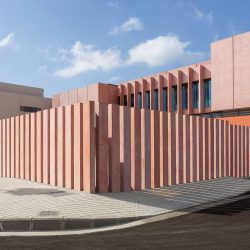
The facade is designed based on prefabricated GRC (Glassfibre Reinforced Concrete) panels, designed and modulated in a way that provides sun protection and expressiveness to the building using only one material, GRC. The coloring is achieved by incorporating pigments into the concrete mass of the panel, thus avoiding the use of paints, which reduces the use of chemicals and provides a finish resistant to the aggressive climatic conditions of the port. The GRC pieces are manufactured in the Canary Islands, promoting local industrialization of construction.
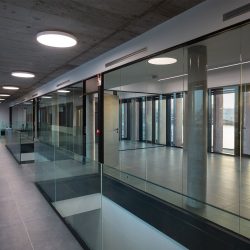
The aluminum used for the carpentry is recycled, as are the textiles employed for the building’s solar control, which come from plastics collected from the sea. Health Safety is an important parameter for organizing and dimensioning the center’s spaces; ventilation, circulation, and their dimension are fundamental to achieving this objective. Cross-ventilation was enhanced in all dependencies. Accessories such as aerators were incorporated into operable facades, allowing for better ventilation control even when the building is closed, thus preventing the proliferation of fungi inside the center as a consequence of the high humidity level in the area.
All construction systems, except the reinforced concrete structure, are designed with modular, prefabricated, and dry systems, which means they are recoverable materials and dismountable systems, allowing for both their recovery for new use and their recycling.·
_





Se trata de un edificio polivalente para el desarrollo de actividades administrativas y otras relacionadas con el entorno del puerto.
La parcela donde se implanta es rectangular, ubicada en un muelle con fachadas longitudinales orientadas Este y Oeste. Se le da prioridad en la estructura funcional del edificio a la orientación oeste por estar vinculada con la ciudad, reservando el lado Este, hacia el interior del muelle para los accesos y zonas de servicio del edificio.
La estrategia de implantación es en forma de "Z", permite organizar el espacio libre de la parcela en dos partes: una al noreste, más noble, destinada a aparcamiento de vehículos oficiales y que corresponde con la entrada principal del edificio, y una segunda al suroeste denominada patio de maniobras, vinculada con la zona de maniobras del Muelle Pesquero y la futura instalación de pantalanes.

La envolvente se proyecta a base de piezas prefabricadas de GRC, diseñadas y moduladas de forma que permiten dar protección solar y expresividad al edificio con la utilización de un solo material, el GRC. La coloración se consigue con la incorporación de pigmentos en la masa del hormigón del panel con lo que se evita la utilización de pinturas, lo que reduce la utilización químicos y la aportación de un acabado resistente a las agresivas condiciones climáticas del puerto. Las piezas de GRC se fabrican en Canarias proponiendo impulsar la industrialización local de la construcción.
El aluminio de las carpinterías es reciclado, así como los textiles empleados para el control solar del edificio, proviniendo estos de plásticos recogidos del mar. La Seguridad Sanitaria es un parámetro importante para organizar y dimensionar los espacios del centro, la ventilación, las circulaciones y su dimensión son básicos para acometer este objetivo. Se potenció la ventilación cruzada de todas las dependencias. A las fachadas practicables se incorporaron accesorios como aireadores permitiendo un mejor control de la ventilación incluso con el edificio cerrado, impidiendo así la proliferación de hongos en el interior del centro como consecuencia del alto grado de humedad de la zona.
Se proyectan todos los sistemas constructivos excepto la estructura que es de Hormigón Armado, con sistemas modulares, prefabricados y secos, lo que permite que sean materiales recuperables y sistemas desmontables permitiendo tanto su recuperación para nuevo uso como su reciclado.